Pass APP 8 and APRA CPS 230 with private cloud AI in Australia
How regulated Australian organisations deploy audit ready private cloud AI. Practical sovereignty checklist, deployment options, and a 6–12 week pilot path.

For regulated Australian organisations, private cloud AI hosted onshore is the recommended posture for automating customer interactions with sensitive data. It gives boards auditability, keeps disclosure obligations under APP 8 straightforward to satisfy, and aligns with APRA CPS 230 expectations. Platforms hosted entirely within Australia offer a practical fit. The next step is a scoped pilot with proper data classification before wider rollout.
TL;DR:
- Data classification and an onshore pilot are essential steps before expanding private cloud AI deployment in regulated Australian organizations.
- Using a region-pinned hyperscaler or self-hosted models provides stronger control and auditability for sensitive customer data.
- Vendors must offer in-country hosting commitments, region-specific inference, tenant isolation, encryption, and immutable audit logs to meet compliance standards.
- Routing requests based on sensitivity, with clear logging of classification decisions, helps reduce risk and simplify audit processes.
- Operational controls and observability, including continuous monitoring and governance steps, are critical for safe, compliant AI production deployment.
Table of Contents
- What does private cloud AI actually mean?
- Why does hosting location matter so much right now?
- Which deployment option should you choose?
- What should your compliance checklist cover?
- How do you run this in production without breaking it?
- A rapid decision path from evaluation to pilot
- How Conversational AI supports your sovereign rollout
- Sources
- FAQ
What does private cloud AI actually mean?
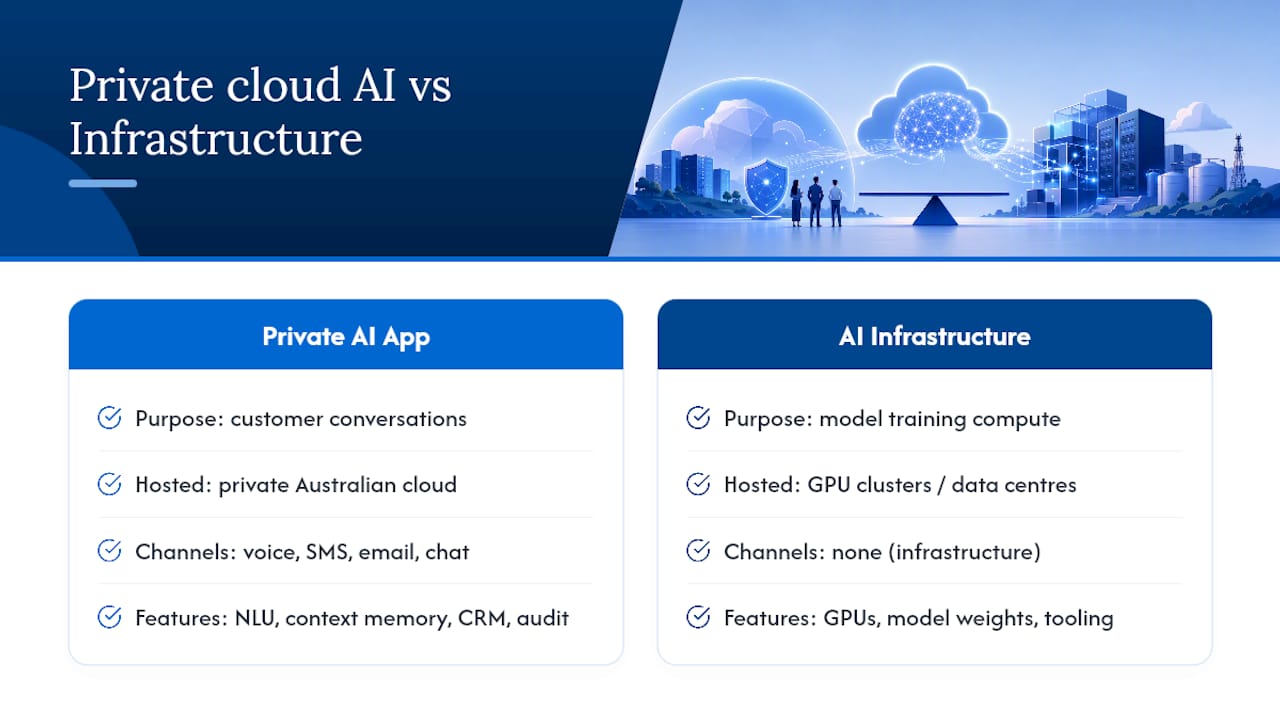
Private cloud AI, in the context that matters to your operations team, is a multichannel conversational AI platform hosted inside a private or sovereign Australian cloud. It handles voice, SMS, email, and live chat conversations for your customers. It is not GPU infrastructure for training large language models. That’s a different procurement decision, run by a different team, solving a different problem.
The platforms worth evaluating share a common feature set: natural language understanding tuned for your industry’s terminology, contextual memory that carries a conversation across channels, CRM integration so agents see the full customer record, audit logs that timestamp every exchange, and role-based access controls that limit who can see what.
This definition matters because regulated buyers get confused between “AI infrastructure” and “AI application.” A healthcare provider doesn’t need to provision GPU clusters. It needs a chatbot that books appointments, escalates clinical queries correctly, and produces an audit trail an OAIC investigator could follow without a translator. Private cloud AI, in this sense, is closer to a compliance-grade communications tool than a data science project.
Why does hosting location matter so much right now?
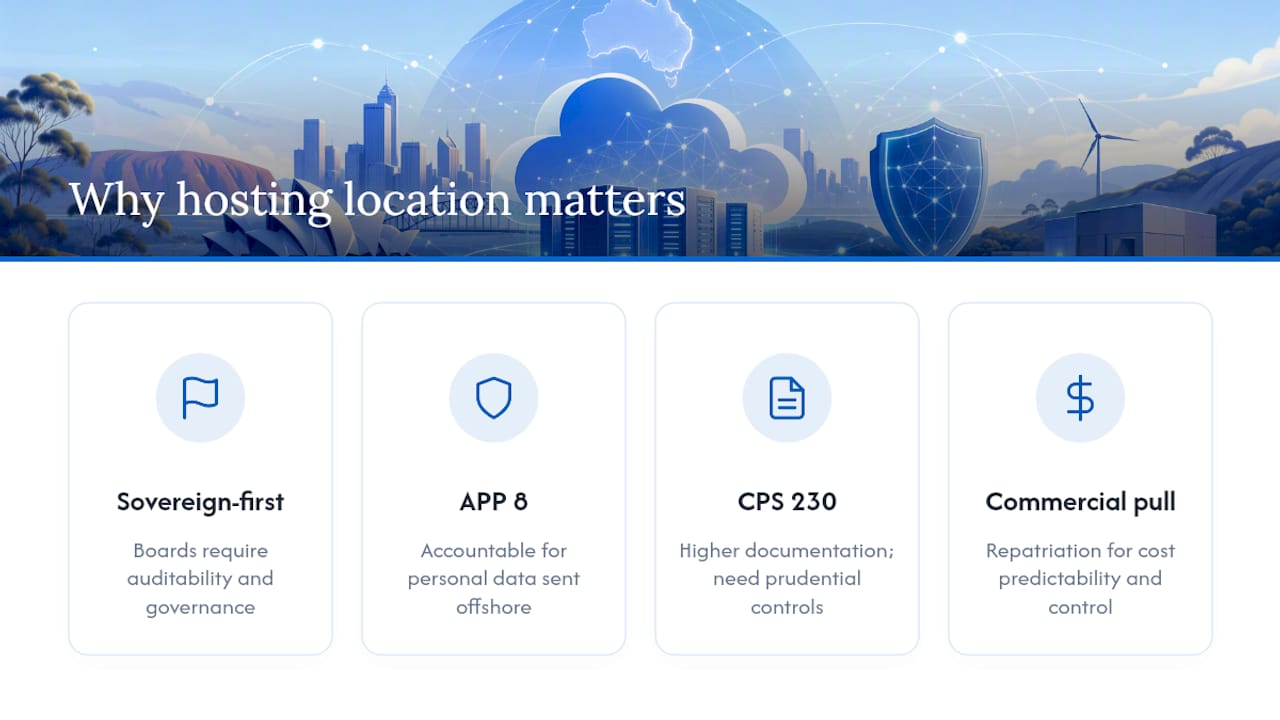
Australian enterprise AI purchasing has shifted from cautious experimentation to what industry analysts call sovereign-first production, where boards demand auditability and governance before they’ll sign off on any AI deployment touching customer data.
Two regulatory forces are driving this. The Australian Privacy Principles, specifically APP 8, don’t ban sending personal information offshore, but they make your organisation accountable for what happens to it once it leaves. Keeping data onshore is the simplest way to reduce that accountability burden, not a legal cure but a practical risk-management posture. APRA CPS 230, meanwhile, has raised documentation expectations for regulated entities, and vendor selection now routinely requires evidence of prudential controls that public multi-tenant clouds struggle to demonstrate cleanly.
There’s a commercial angle too. Enterprises across the Asia-Pacific region are actively repatriating AI workloads to private cloud for cost predictability and control, and providers like Interactive have responded by launching sovereign private cloud products specifically built for AI workloads. Onshore hosting isn’t a niche compliance play anymore. It’s where the market is heading.
Which deployment option should you choose?
Four topologies dominate the Australian market, and they differ enormously in what actually stays onshore.
Direct vendor API with at-rest residency keeps stored data in Australia but often routes the inference call itself through an overseas endpoint. It’s the cheapest and fastest to stand up, and it can work for low-sensitivity tasks like general FAQ handling. For anything touching personal, health, or financial data, it’s not recommended.
Hyperscaler-hosted model in an Australian region, with inference pinned to that region, keeps both data and processing onshore. Engineering effort is moderate, unit costs sit mid-range, and it’s generally suitable for APRA-regulated workloads provided the contract confirms region pinning rather than just data centre location.
Self-hosted open-weight models on Australian GPUs give you the tightest control and the strongest audit story, at the cost of real engineering effort and higher fixed costs. This suits large regulated entities running high volumes of sensitive conversations where control outweighs convenience.
Hybrid routing by sensitivity is increasingly the standard production pattern: a policy layer classifies each request and sends it to the appropriate endpoint.
A workable routing rule for most regulated teams:
- Route requests containing personal, health, or financial data to region-pinned inference or a self-hosted model.
- Route general or low-sensitivity queries (opening hours, product FAQs) through a standard API if cost matters more than residency.
- Log the classification decision itself, not just the conversation, so auditors can see why a request went where it did.
If you’re unsure which bucket a workflow falls into, treat it as sensitive by default. It’s cheaper to over-classify early than to explain a misrouted later.
What should your compliance checklist cover?
Before signing anything, IT, security, and compliance teams need a shared checklist that survives audit scrutiny, not just a sales conversation.
- Vendor contract and subprocessors. Confirm in-country hosting commitments in writing, get the full subprocessors list, understand data retention periods, and check whether customer conversations are used to improve the vendor’s models. Pin down incident notification SLAs.
- Technical controls. Verify tenancy isolation (not just “Australian data centre” marketing), region-pinned inference, tenant-isolated vector stores for any retrieval-augmented setup, encryption at rest and in transit, role-based access control, and immutable audit logging with a defined retention policy.
- Operational controls. Confirm data classification processes exist, that de-identification or tokenisation is applied where appropriate, and that model changes go through a governance step rather than shipping silently.
- Pilot acceptance criteria. Ask for sample logs, cost and latency figures at three traffic levels, and a completed security assessment before scaling beyond pilot.
For APRA-regulated entities, tenant-isolated stores with immutable logs cut evidence-gathering time significantly compared with multi-tenant public cloud setups, because you’re not chasing a vendor to prove your data was never mixed with someone else’s.
Pro Tip: Ask vendors for a sample audit log before you sign, not after go-live. If they can’t produce one on request, that’s your answer about how audit-ready the platform really is.
How do you run this in production without breaking it?
Integration is where private cloud AI projects usually stall, not the model itself. You’ll need connectors into your CRM, single sign-on for staff access, telephony or SIP trunking for voice channels, SMS gateway integration, email relay configuration, and a web chat widget that doesn’t fight your existing site. None of this is exotic, but each connector is a point of failure if it’s rushed.
Observability matters just as much as the initial build. You need per-tenant logging of every prompt and output, latency and cost telemetry so you can catch drift before it becomes a budget problem, and audit trails with genuine tamper evidence, not just a database table someone could edit.
Operationally, someone in IT or ops owns day-to-day monitoring, compliance runs periodic checks against the original data classification, and model updates go through an approval step rather than auto-deploying. On cost, expect a subscription-plus-implementation model for most platforms, versus significant capital expenditure if you self-host GPUs. Repatriation from public cloud only pays off once volume and sensitivity both justify the fixed cost.
A rapid decision path from evaluation to pilot
The fastest defensible path is: classify your data first, then pick one narrow pilot use case, define KPIs and the exact audit evidence you’ll need, and run it for six to twelve weeks. Don’t try to automate everything at once.
Appointment booking, lead qualification, and collections triage are good starting points. They deliver real operational value while limiting compliance exposure, since none of them typically require exposing your most sensitive records on day one.
Judge success by what changes operationally: less manual handling time, clean audit logs an auditor could follow unaided, and zero unplanned cross-border data exposure. If a pilot can’t produce all three, it’s not ready to scale.
— Sowrabh
How Conversational AI supports your sovereign rollout
Some platforms are built specifically for this checklist, hosting entirely within Australia, running tenant-isolated environments so data does not mix between clients, and delivering multichannel agents across voice, SMS, email, and live chat with CRM integration. Audit logging and contextual memory often come standard, which matters when compliance teams ask for evidence, not promises.
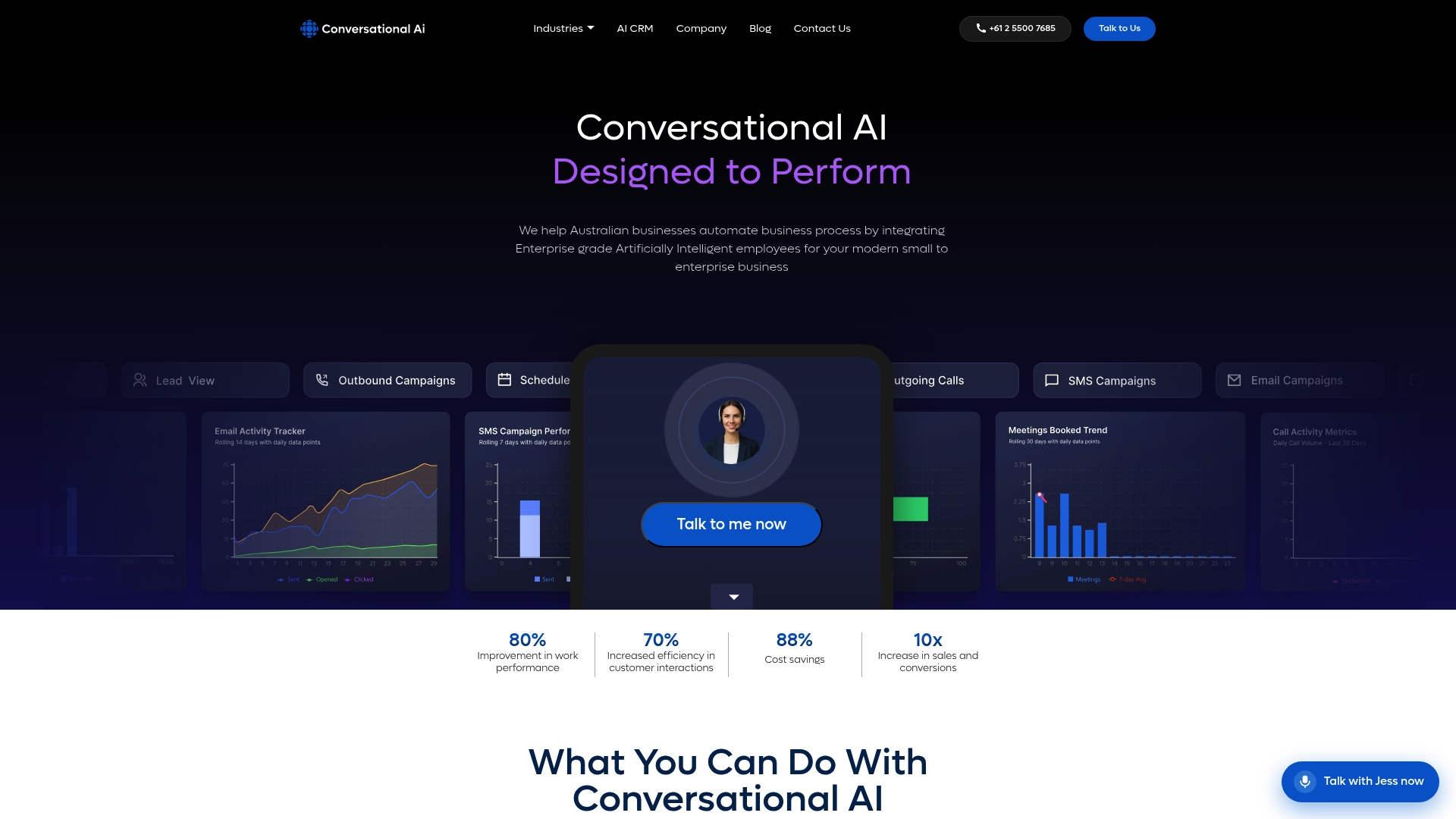
If you’re working through the deployment decision outlined above, the practical next step is a scoping conversation rather than a long procurement cycle. You can request a pilot scope, review how the platform handles data classification and routing for your industry, or start with a narrow use case like appointment booking or collections triage. Visit Conversational AI to arrange a scoping call and see how the onshore architecture maps to your existing CRM and telephony setup.
Sources
For deeper technical grounding, see Conversational AI’s guide to sovereign AI architecture and compliance, the 90-day residency versus sovereignty playbook, and, for readiness benchmarking, West Legacy Group’s AI visibility report.
- Private AI: from sovereignty obligation to business advantage
- AI deployment options in Australia: API, VPC or self‑host
- Interactive launches sovereign Private Cloud to enhance control and performance for Australian organisations
FAQ
Is data residency the same as data sovereignty?
No. Residency means data is stored in Australia; sovereignty means it’s also governed under Australian law and free from foreign legal reach, which is why APP 8 treats offshore disclosure as an accountability issue, not just a location one.
Can we use a direct overseas API for our chatbot?
Only for low-sensitivity tasks. For anything involving personal, health, or financial data, region-pinned inference or self-hosting is the safer, more auditable choice.
How long should a private cloud AI pilot run?
A realistic private cloud AI pilot runs several weeks, delivering a written residency posture, a chosen deployment topology, cost estimates for different traffic volumes, and a working prototype of that final topology.
What evidence do auditors actually want to see?
Immutable audit logs with defined retention, tenant isolation proof, and a documented data classification process, all of which platforms like Conversational AI generate as standard output rather than a custom report.
When does self-hosting make more sense than an API?
Once volume and data sensitivity are both high enough that control and audit simplicity outweigh the extra engineering effort and capital cost of running your own infrastructure.