Architects: Decide Tenancy in 5 Gates to Pick Single or Multi Tenant
Practical guide for architects: a five gate decision tree and four deployment patterns to choose single or multi tenant, plus hybrid and private options...

Multi-tenant architecture is the right default for most products because it generally reduces cost and speeds up onboarding. Single-tenant architecture is preferred when isolation, regulatory compliance, or predictable performance under load are essential requirements. Most mature platforms end up running a hybrid model, serving the majority of customers on shared infrastructure while carving out isolated environments for the enterprise accounts that demand it.
TL;DR:
- Multi-tenancy offers significant cost savings and rapid onboarding, especially when tenants have uniform workload patterns and compliance is not a strict concern.
- Single-tenancy provides better customization, isolated performance, and simpler security, making it essential for regulated industries or when strict data isolation is required.
- The most common deployment patterns include shared application and database, schema-per-tenant, and fully isolated databases, with hybrid models balancing cost and isolation needs.
- Operational challenges for multi-tenant systems include complex patching, tenant-aware monitoring, and tenant-specific backups, which are simpler in single-tenant environments.
- Hybrid and private deployment options enable compliance-focused organizations to achieve isolation without managing infrastructure themselves, often through dedicated cloud regions or on-premise solutions.
Table of Contents
- Single tenant vs multi tenant: what each term actually means
- The real trade-offs: cost, scale, customisation and performance
- Tenancy models and deployment patterns you’ll actually build
- A decision tree for choosing single or multi tenant
- Running the operations: onboarding, releases and backups
- Security, blast radius and who can prove what to an auditor
- Hybrid models and how teams migrate between them
- What to do next
- How Conversational AI approaches tenancy for enterprise customers
- Where private deployment fits your architecture
- Sources
Single tenant vs multi tenant: what each term actually means
Before you weigh trade-offs, get the vocabulary locked down. Single-tenant architecture means one customer gets a dedicated application instance, a dedicated database, and often dedicated infrastructure underneath it. Nothing is shared. Multi-tenant architecture means one application instance serves many customers, with their data kept logically separate rather than physically separate.
That logical separation can be implemented three ways, and the choice shapes everything downstream:
- Shared schema — all tenants sit in the same database and tables, separated by a tenant ID column on every row.
- Schema-per-tenant — one database, but each tenant gets its own schema or namespace inside it.
- Database-per-tenant — a dedicated database per customer, though the application layer stays shared.
Each step down that list buys more isolation and costs more to run.
The real trade-offs: cost, scale, customisation and performance
The single tenant vs multi tenant comparison usually comes down to four axes, and they rarely all favour the same model.
Cost and onboarding. Multi-tenant wins decisively here. Updates and patches roll out once, across every customer, instead of once per deployment. That’s the core of why multi-tenancy reduces cost per customer compared with provisioning a dedicated environment for each new signup. Onboarding a new customer on a shared platform can be near-instant; onboarding onto isolated infrastructure means standing up new compute, storage, and network config every time.
Customisation and performance. Single-tenant flips the advantage. A dedicated environment lets you tune resources, apply customer-specific configuration, and guarantee that one tenant’s traffic spike never touches another’s response times. There’s no noisy-neighbour effect because there’s no neighbour.
Statistic callout: Platform architects at Capital One argue that multi-tenancy is foundational for scaling without linear cost increases, but only when strict logical boundaries prevent cross-tenant leakage. Skip that discipline and the cost savings evaporate the first time a bug bleeds data between customers.
Operations. Multi-tenant means one release cadence and one support playbook. Single-tenant means patching, testing, and supporting N environments, which slows feature delivery as your customer count grows.
Tenancy models and deployment patterns you’ll actually build
Architects don’t pick from a binary. In practice, four patterns cover almost every production system:
- Shared app, shared database (shared schema). The cheapest and fastest to build. Every tenant lives in the same tables, filtered by tenant ID. Isolation is entirely a software concern, so a query bug is a data-leak risk.
- Shared app, schema-per-tenant. Still one application instance, but each tenant gets its own schema. This narrows the blast radius of a bad query without the overhead of separate databases.
- Database-per-tenant or fully isolated deployments. The application may still be shared, or each tenant may get its own instance entirely. This is where true single-tenant lives, and it’s the model regulated customers usually insist on.
- Deployment stamps and horizontal partitioning. Rather than one giant shared platform or thousands of isolated ones, you deploy identical “stamps” of the full stack, each serving a subset of tenants. Microsoft’s Azure architecture guidance describes this as a middle path that limits how many tenants share a failure domain while keeping most of multi-tenant’s cost efficiency.
A decision tree for choosing single or multi tenant
Run these gates in order. The first one that fails to clear routes your answer.
- Gate 1: Compliance and data residency. If a regulator or contract mandates physical data separation or a specific hosting jurisdiction, you go single-tenant immediately. Practical decision-tree frameworks put this gate first because it’s non-negotiable, not a trade-off to weigh.
- Gate 2: SLA and isolation requirements. Does one customer’s usage spike need to be structurally incapable of degrading another’s? If yes, lean single-tenant or a deployment-stamp model.
- Gate 3: Workload shape. Are your tenants roughly uniform in size and usage pattern, or wildly heterogeneous? Uniform workloads suit shared schema; heterogeneous ones push you toward partitioning.
- Gate 4: Business model. A handful of large enterprise accounts justifies the operational overhead of isolation. Thousands of small accounts don’t. Match the tenancy model to how you actually sell.
- Gate 5: Operational readiness. Do you have infrastructure-as-code and automated provisioning mature enough to spin up isolated environments on demand? If not, single-tenant at scale will bury your operations team.
Pro Tip: Don’t run this decision tree once at the start and forget it. Revisit gate 4 every time your sales team lands a customer type you haven’t served before. The tenancy model that fit your first 50 customers rarely fits your next 500.
Running the operations: onboarding, releases and backups
Tenancy choice shows up hardest in day-to-day operations, not in the initial architecture diagram.
- Patching: multi-tenant means one coordinated rollout; single-tenant means patching and maintenance repeat per customer, which slows delivery as the customer count climbs.
- Onboarding: shared-schema multi-tenant onboarding can be a database insert. Database-per-tenant onboarding needs infrastructure-as-code to avoid becoming a manual, error-prone ritual.
- Observability: multi-tenant systems need tenant-aware monitoring and throttling, because one tenant’s traffic spike can degrade every other tenant sharing that instance unless you’ve built quotas and partitioning to contain it.
- Backups and restore: single-tenant makes point-in-time restore for one customer trivial. Multi-tenant restores usually mean restoring everyone, or building tenant-level backup tooling most teams underinvest in.
Security, blast radius and who can prove what to an auditor
A breach in a single-tenant environment stays contained to one customer’s data. A breach in a shared-schema multi-tenant system can, in the worst case, touch every tenant on that instance, which is why single-tenant architecture remains the preferred model for regulated industries with strict security and audit requirements.
Isolation also simplifies forensics. When an incident happens on a dedicated environment, the evidence trail belongs to one customer, with no need to untangle it from anyone else’s logs.
- Row-level security and tenant-ID enforcement at the database layer, not just the application layer.
- Automated tests that specifically try to fetch another tenant’s data and confirm they fail.
- Separate encryption keys per tenant where the platform supports it.
- Audit logging that tags every access with tenant context, even in a shared instance.
Sovereign, private AI deployments built for regulated sectors often bake several of these controls in by default rather than leaving them to each engineering team to reinvent.
Hybrid models and how teams migrate between them
Most platforms that survive long enough don’t stay purely one model. A shared multi-tenant core handles the bulk of customers, while a handful of enterprise accounts get isolated storage or fully separate deployments. Hybrid architecture lets you serve many small customers cheaply while still meeting the isolation demands of the few large ones who need it, often at a premium price that funds the extra infrastructure.
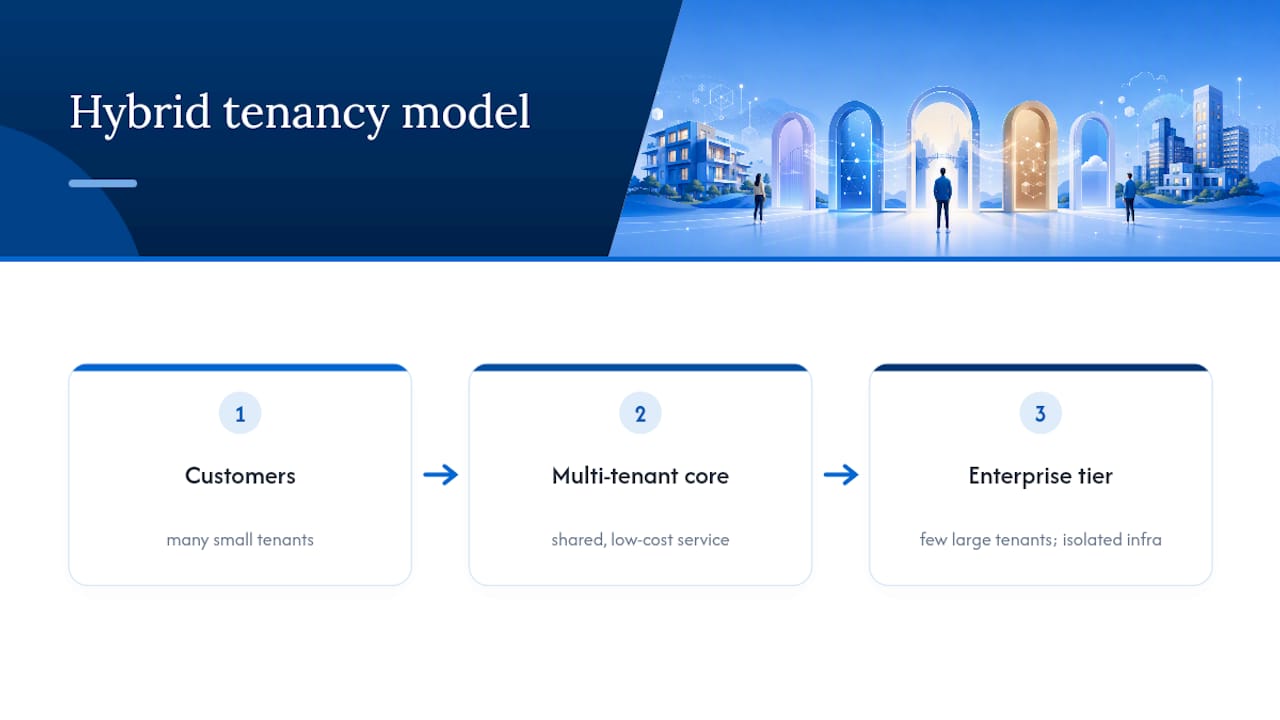
Migration in either direction is genuinely hard. Moving a tenant from shared to isolated infrastructure involves data export, schema migration, re-provisioning, and reconfiguring deployment pipelines. Automated infrastructure-as-code and data-migration tooling cut that cost substantially, but manual migrations tend to become one-off projects that eat weeks of engineering time.
What to do next
For most SaaS products, build multi-tenant first and design the isolation boundary in from day one, so it’s a configuration change later, not a rewrite. Reach for single-tenant only when a compliance gate, contract, or performance SLA forces it. Next: run the decision tree against your actual customer base, prototype the two most likely models, load-test them, and measure onboarding time and infrastructure cost per tenant before committing.
How Conversational AI approaches tenancy for enterprise customers
The platform runs on private, Australia-hosted infrastructure with hybrid deployment options built in. Enterprises in healthcare, finance, and professional services typically choose private deployments when data sovereignty or audit requirements rule out shared infrastructure. See our guide on sovereign cloud data control for the compliance detail.
Where private deployment fits your architecture
If your organisation has already decided that shared infrastructure won’t clear your compliance gate, the choice isn’t really single versus multi-tenant anymore. It’s which private deployment gives you isolation without forcing your engineering team to build and maintain that infrastructure themselves. The platform runs entirely on Australia-hosted infrastructure, with private and hybrid deployment options for organisations in healthcare, finance, real estate, and professional services that need dedicated environments alongside standard multi-channel automation for voice, SMS, email, and live chat.
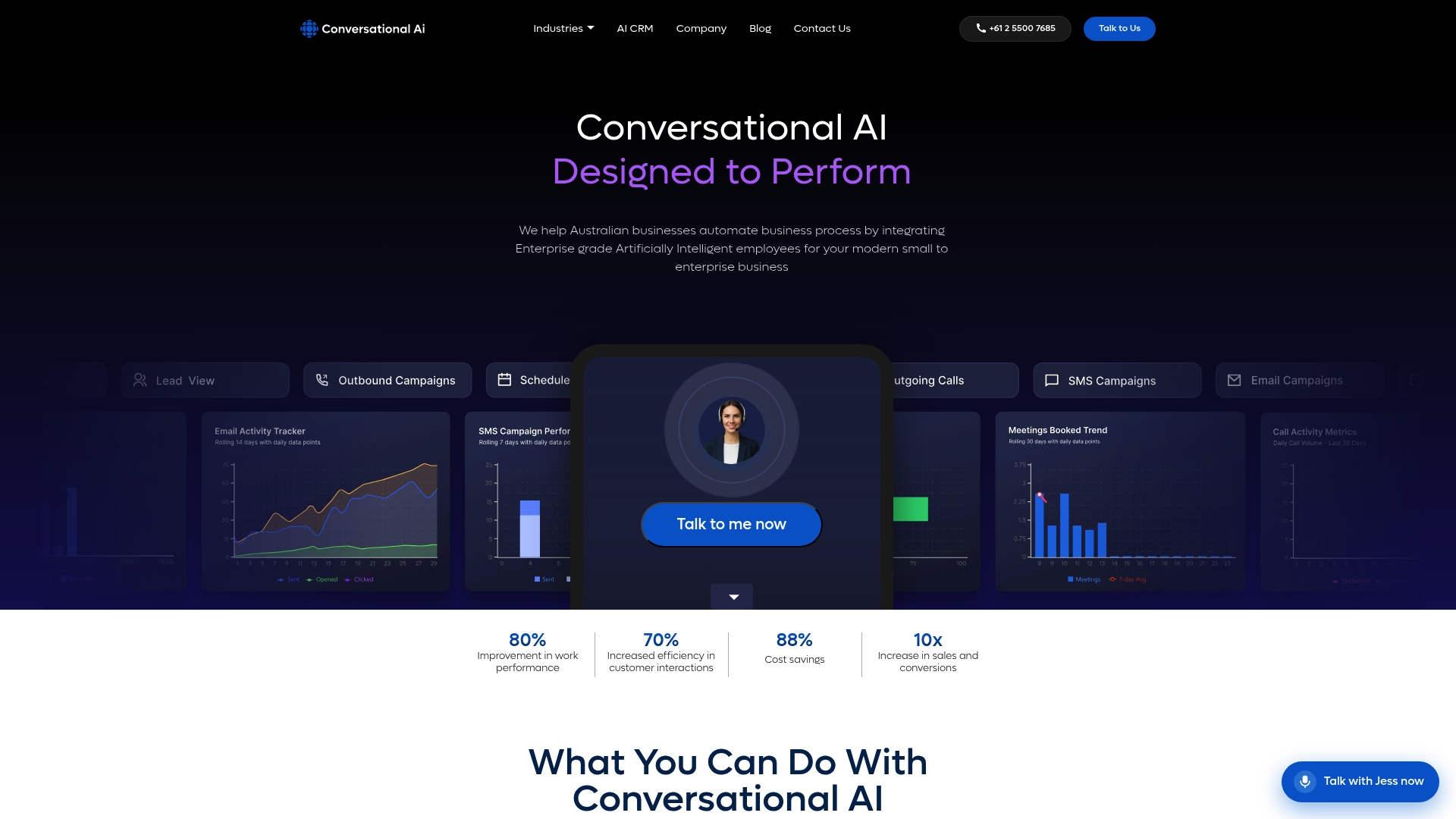
That combination matters most for teams that have already ruled out shared multi-tenant SaaS on compliance grounds but don’t want to run their own AI infrastructure from scratch. Rather than choosing between a shared platform that fails your audit and a build-it-yourself deployment that consumes your engineering roadmap, you get a dedicated environment with CRM integration, contextual memory, and automated follow-ups already built. If data residency, isolation, or auditability are the reason you’re reading this article, visit the Conversational AI platform page to see how a private deployment maps to your architecture, and request a walkthrough of the hybrid model options for your sector.
Sources
- What is multi-tenancy? Pros, cons and best practices | WorkOS
- Single-tenant vs multi-tenant architecture — which to choose? | Leobit
- Tenancy models for a multitenant solution | Microsoft Learn
- Multi-Tenancy: The non-negotiable foundation for scaling platforms | Capital One Tech