Conversational commerce: what it means for Australian businesses
Discover what is conversational commerce and how it can boost Australian businesses. Learn to engage customers with real-time dialogue.

Conversational commerce is the practice of using messaging apps, chatbots, and voice assistants to hold real-time, two-way conversations that guide customers from product discovery through to purchase. The term was coined by Chris Messina in 2015 to describe the intersection of messaging and shopping, and the concept has grown considerably since then. Today it runs on natural language processing (NLP), artificial intelligence, and large language models (LLMs) that can understand intent, remember context, and respond in ways that feel genuinely human. It is not the same as conversational marketing, which focuses on lead generation and engagement. Conversational commerce goes further: it facilitates actual transactions within the conversation itself.
A few things define it in practice:
- Real-time dialogue across channels including webchat, SMS, voice, and messaging apps
- AI-powered understanding through NLP and LLMs that interpret customer intent accurately
- CRM integration that carries conversation history and personalisation across every touchpoint
- Human handoff capability so complex queries escalate to a live agent without losing context
- Transaction completion inside the conversation, from product selection through to payment
For Australian businesses, platforms like Conversational AI bring these capabilities together in a locally hosted, privacy-compliant environment, which matters considerably given Australia’s data sovereignty requirements.
How does conversational commerce actually work?
The mechanics are more layered than a simple chatbot script. When a customer sends a message, whether through a website widget, WhatsApp, or a phone call, the system uses NLP to parse the intent behind the words. An LLM then generates a contextually relevant response, drawing on product data, order history, and CRM records to personalise the reply. As of 2025, large language models are actively helping buyers discover new products in ways that go well beyond the keyword-matching of classic chatbots.
The technology stack typically includes:
- NLP and speech recognition to interpret text and voice inputs accurately
- AI agents that handle routine queries, product questions, and order tracking automatically
- E-commerce and payment integrations so transactions complete inside the conversation
- CRM connectors that surface customer history and preferences in real time
- Escalation protocols that transfer the conversation to a human agent when complexity or sentiment warrants it
That last point deserves attention. Poorly managed handoffs between AI and human agents are one of the most common causes of customer frustration. Sentiment analysis and complexity triggers, built into the platform logic, help the system recognise when a bot should step aside. When the handoff carries full conversation context, the customer never has to repeat themselves.
Conversational commerce integrates chatbots, voice assistants, and messaging platforms with e-commerce systems, CRM tools, and payment processors to enable real-time assistance, personalised recommendations, and data gathering within a single interaction. That integration is what separates a genuine conversational commerce deployment from a basic FAQ bot.

Pro Tip: Map your customer journey before selecting a platform. The channels your customers already use, whether that is SMS, voice, or webchat, should drive your technology choices, not the other way around.
What are the real benefits of conversational commerce?
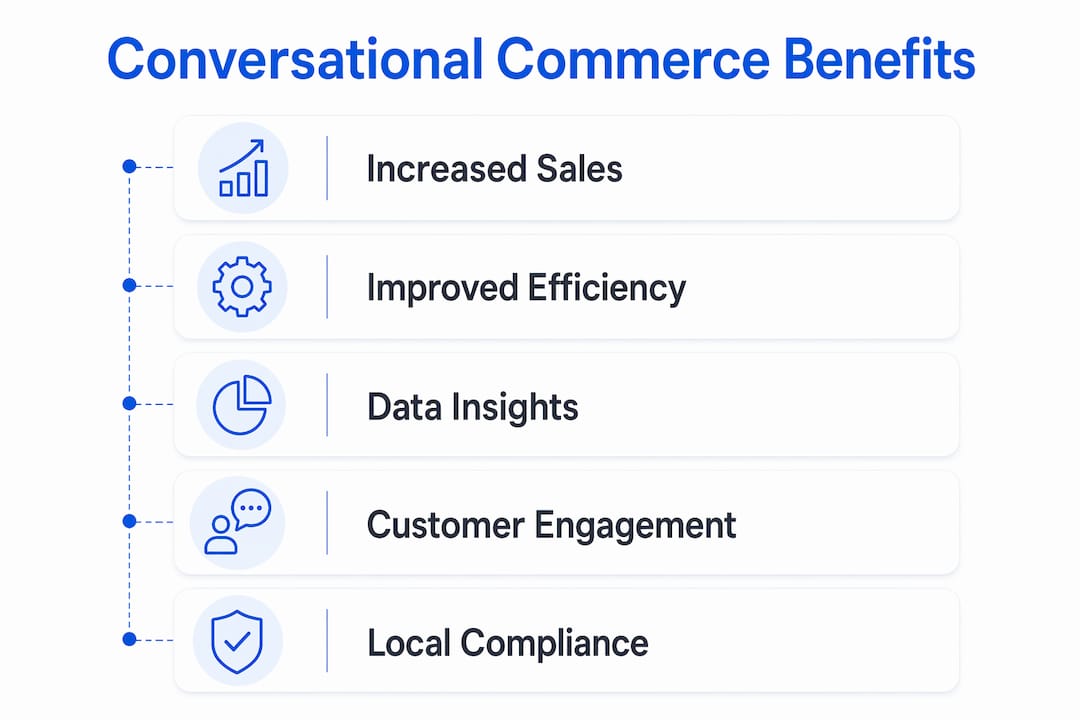
The business case is grounded in what customers actually want: fast answers, relevant recommendations, and frictionless transactions. Conversational commerce enhances customer satisfaction and retention by enabling personalised service and effortless transactions, replacing the frustration of long hold times and generic email responses.
The benefits stack up across several dimensions:
- Higher conversion rates because guided, contextual conversations reduce the hesitation that kills online sales
- Increased average order value through real-time upselling and cross-selling during the conversation
- Reduced support costs as AI agents handle routine queries around the clock without adding headcount
- Stronger customer retention built on relationships rather than one-off transactions
- Richer data collection from every conversation, feeding better marketing decisions and product development
For marketers specifically, the data angle is underappreciated. Every conversation generates structured intent signals: what customers asked, what they hesitated on, what they ultimately bought. That feeds directly into segmentation, campaign targeting, and product strategy in ways that anonymous web analytics simply cannot match.
The efficiency gains are real for operations teams too. Automating appointment booking, order status queries, and lead qualification frees your human agents to focus on the interactions that genuinely need a person. The enterprise benefits of conversational AI in sectors like finance and professional services show this pattern consistently: automation handles volume, humans handle nuance.
Where do businesses actually use conversational commerce?
The applications span the full customer lifecycle, not just the point of sale. Conversational commerce is used across personalised shopping assistance, customer support, order tracking, sales lead qualification, and appointment booking, making it relevant to almost every customer-facing function.
In practice, Australian businesses are deploying it across several distinct scenarios:
- Product discovery and recommendations where a chatbot asks a few qualifying questions and surfaces the right product, cutting through catalogue overwhelm
- Order tracking and post-sale support handled automatically via SMS or webchat, reducing inbound call volume
- Lead qualification in professional services, where an AI agent collects requirements and books a consultation before a human ever gets involved
- Appointment scheduling in healthcare and allied health, where patients book, reschedule, and receive reminders through a single conversational interface
- Upselling during checkout when an AI agent recognises cart contents and suggests a relevant add-on at exactly the right moment
Retail is the most visible use case, but professional services firms are finding strong returns from bilingual AI receptionists and automated intake flows that handle client enquiries in multiple languages without adding reception staff. The channel flexibility matters here: a law firm and an online retailer both benefit from conversational commerce, just through different touchpoints.
It is worth distinguishing conversational commerce from social commerce, which focuses on selling within social media platforms. Conversational commerce emphasises real-time two-way interaction regardless of channel, whether that is a website widget, a phone call, or an SMS thread.

Which platforms suit Australian businesses best?
Platform selection in Australia comes with a constraint most offshore guides overlook: data sovereignty. Hosting customer conversation data on overseas infrastructure creates compliance exposure under the Privacy Act 1988, particularly for businesses in healthcare, finance, and legal services. Australian Privacy Act compliance requires that cross-border data transfers meet strict adequacy standards, and for many enterprise clients, local hosting is the only acceptable answer.
Conversational AI is built specifically for this environment. The platform hosts entirely within Australia, giving enterprises full data control and compliance confidence without needing to negotiate offshore data processing agreements. Its capabilities include:
- Multi-channel AI agents covering voice, SMS, email, and live chat from a single platform
- Contextual memory that carries conversation history across sessions and channels
- Natural language understanding tuned for Australian English and local business contexts
- CRM integration with existing enterprise infrastructure, so personalisation is immediate rather than bolted on later
- Real-time analytics that surface conversation trends, resolution rates, and escalation patterns
For healthcare providers, the local hosting removes a significant governance barrier. For financial services firms, it supports compliance with both the Privacy Act and sector-specific obligations. The role of chatbots in customer support is well established, but the difference between a generic chatbot and an enterprise-grade conversational AI platform is the depth of integration, the quality of handoff protocols, and the security of the underlying infrastructure.
Successful conversational commerce also depends on ongoing optimisation. Set-and-forget automation consistently underperforms compared to implementations that are regularly reviewed, retrained on new data, and adjusted as customer behaviour evolves.
Key takeaways
Conversational commerce delivers measurable business value when AI, CRM integration, and human oversight work together within a privacy-compliant infrastructure.
| Point | Details |
|---|---|
| Transactions, not just engagement | Conversational commerce completes sales through dialogue, going beyond lead generation or marketing chat. |
| CRM integration is non-optional | Without conversation history in the CRM, personalisation is superficial and customers notice immediately. |
| Human handoff quality determines trust | Context-aware escalation to a live agent prevents frustration and protects brand reputation. |
| Data sovereignty shapes platform choice | Australian businesses must host conversation data locally to meet Privacy Act obligations, especially in healthcare and finance. |
| Ongoing optimisation drives results | Platforms reviewed and retrained regularly outperform static deployments across every key metric. |
Why Australian businesses cannot afford to treat this as optional
The gap between businesses that have deployed conversational commerce well and those still relying on static contact forms is widening faster than most marketing teams realise. Customers have been trained by the best digital experiences to expect immediate, relevant, personalised responses. A generic auto-reply or a three-day email turnaround now reads as indifference.
What I find most overlooked in Australian market discussions is the data sovereignty angle. Offshore platforms often bury data residency terms in their service agreements, and many businesses only discover the compliance implications after they have already integrated the tool. For a GP clinic or a financial planning firm, that is not a minor administrative issue. It is a genuine risk to client trust and regulatory standing. The Privacy Act 1988 is not ambiguous on cross-border transfers, and the Australian Information Commissioner has been increasingly active in enforcement.
The other thing worth saying plainly: automation alone does not build customer relationships. The businesses getting the best results from conversational commerce are the ones that treat AI as the first responder, not the only responder. They use AI to handle volume, qualify intent, and gather context, then bring a human in at exactly the moment the conversation needs one. That balance is harder to get right than any vendor will tell you, and it requires deliberate design, not just a default escalation rule.
Australian enterprises that invest in locally hosted, CRM-integrated conversational AI now are building a capability that compounds over time. Every conversation generates data. That data improves the model. The model improves the next conversation. Businesses that start later will be playing catch-up against competitors whose AI has already learned from thousands of real customer interactions.